How to Separate Business Revenue into Taxes, Expenses, Savings and Reinvestment
When every payment lands in one undifferentiated balance, it is easy to spend money that already belongs to a supplier, a tax obligation or next month's operating costs. Allocation does not create extra revenue. It gives the money you have a clear purpose and makes competing demands easier to review.
1. List obligations before choosing percentages
Start with the bills and commitments your business actually has. Include regular operating costs, supplier invoices, payroll, debt payments, tax obligations and planned stock purchases. Separate recurring costs from one-off purchases and identify when each payment is due. Keep different businesses and currencies separate.
Compare that list with realistic incoming revenue, including a weaker sales period. A rule that covers bills only during your best month is not a reliable plan. Where costs are fixed, a percentage may need a minimum reserve or a separate cash-flow review. Do not copy another seller's split without checking your own margins.
2. Distinguish Sales Tax from a tax reserve
Tax collected from customers on behalf of an authority is not the same as a reserve for your business's own tax bill. Determine which taxes apply, what your provider reports and whether the amount entering the allocation step already excludes any tax or fees. Subtracting the same item twice understates available revenue.
A chosen Tax Vault percentage is not your legally correct tax rate. Jurisdiction, entity structure, deductions and timing all matter. Agree an appropriate reserve and review schedule with a qualified adviser. Setting funds aside does not prepare a return, file it or guarantee enough money for the eventual liability.
3. Give each category a specific job
- Taxes: a reserve toward defined obligations, distinct from separately collected Sales Tax where applicable.
- Operating Expenses: the recurring costs of keeping the business running.
- Capital or reinvestment: planned stock, equipment or growth spending.
- Savings: a contingency or a named future goal.
- Flexible Spending: discretionary capacity after the other categories have been considered, not automatically distributable profit.
Use labels and rules your team can understand. The category name does not override an actual unpaid bill. If one reserve is consistently short while another grows unused, investigate the costs and timing before simply moving money between categories.
4. Preview a complete example
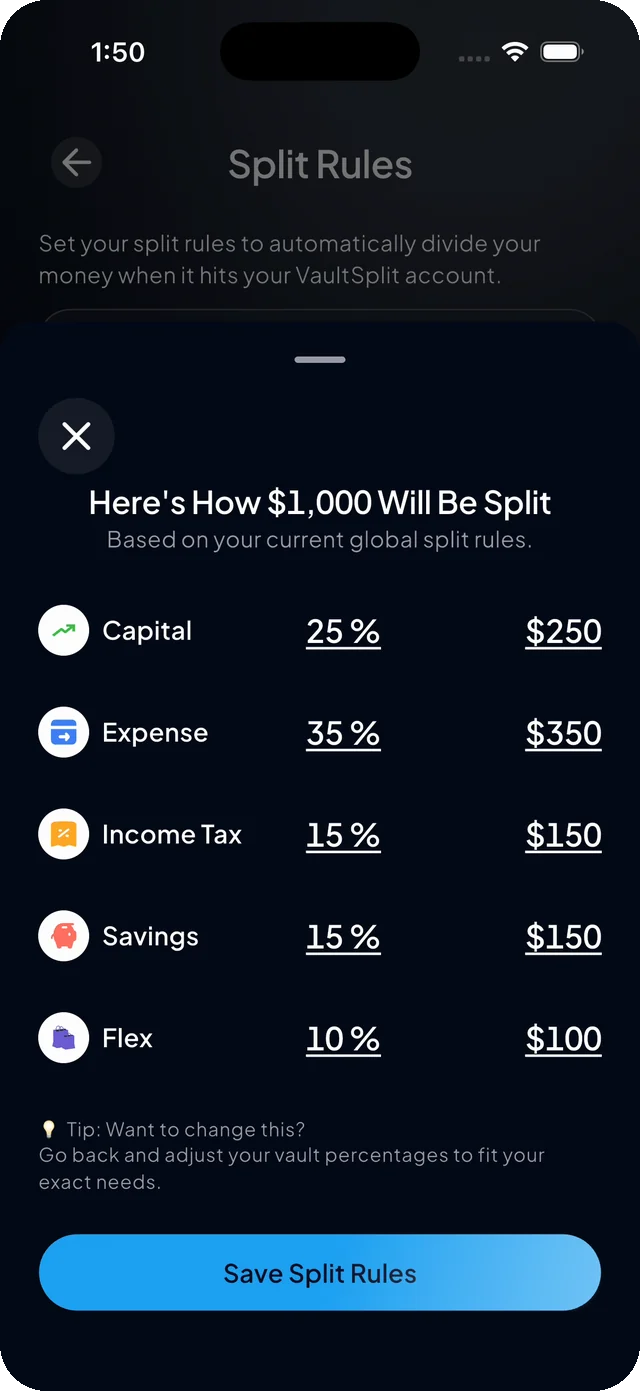
Assume $1,000 of revenue is available for allocation after any separately handled Sales Tax and applicable source deductions. It is not $1,000 of gross customer charges awaiting those deductions. The following percentages are illustrative choices, not recommendations:
- Operating Expenses: 35% = $350.
- Capital: 25% = $250.
- Taxes: 15% = $150.
- Savings: 15% = $150.
- Flexible Spending: 10% = $100.
The percentages total 100% and the allocated amounts total $1,000. The 15% tax reserve is only an example, not a tax rate. The flexible amount is not a guarantee of affordability: missing obligations, refunds or changing bills could reduce it. Repeat the exercise with a smaller revenue amount and check whether essential payments remain covered.
5. Configure the repeatable step
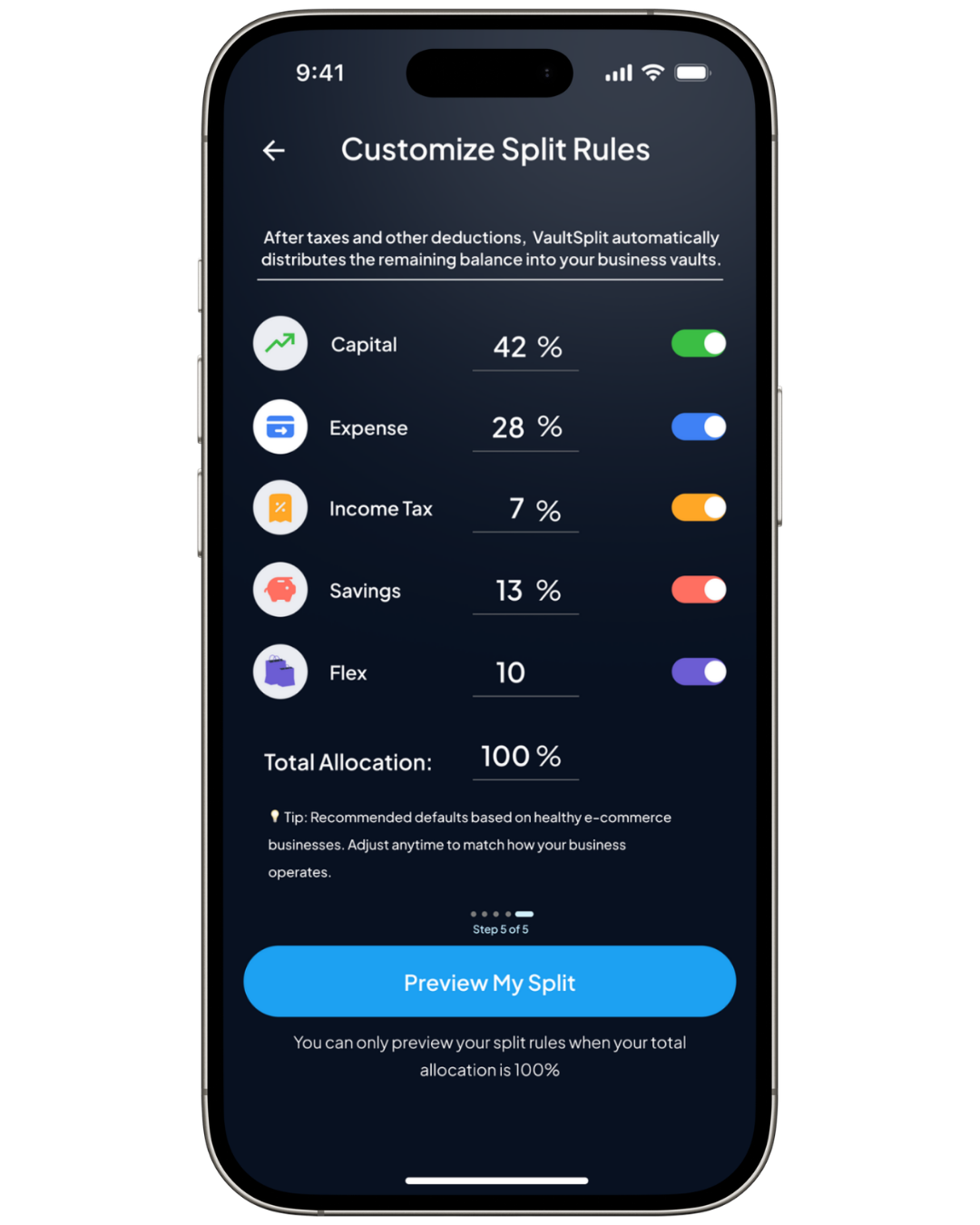
In VaultSplit, connect an eligible supported revenue source, choose the business, configure its allocation percentages and preview the result before saving. Supported incoming revenue is organized into vaults under those rules. The current app's split preview shows a sample allocation; screenshots are not customer results.
Provider coverage matters. Stripe connectivity is subject to country and account eligibility, and a WooCommerce connection does not cover every plugin or gateway. Shopify is not enabled for the current V1 release. A vault allocation is also not a promise that a provider payout has already settled or that money has moved to an external bank account.
6. Reconcile and adjust deliberately
At a regular review, compare recorded payments, fees, refunds and payouts with the source reports. Keep unresolved differences visible. Check upcoming bills and whether each reserve remains appropriate. A rule change should not be assumed to rewrite historical records; verify its effective scope before relying on it.
The double-entry ledger and available exports help with that review, but source coverage still determines completeness. AI CFO answers depend on recorded data and supported questions. Review the applicable confirmation before a financial action, and involve your accountant when the records or tax treatment are uncertain.
Before switching on a rule
- Confirm the source, business, currency and allocatable amount.
- Check Sales Tax treatment and avoid duplicate deductions.
- Confirm that categories cover actual obligations and total 100%.
- Preview amounts, review plan fees and schedule your first reconciliation.
Read how automated allocation works, why sales are not available cash and how reconciliation fits. Compare plans and allocation fees, or discuss your workflow with the team.
General education only, not financial or tax advice. The figures are transparent illustrative assumptions, not recommended percentages, customer outcomes or a guarantee of profitability.